


Most candidates preparing for Clinical Data Analytics roles believe hiring decisions are driven by certifications, tools, or years of experience. In reality, none of these guarantee selection.
Clinical analytics hiring—especially in regulated environments—follows a very different logic. This edition breaks down what hiring managers actually evaluate and why many otherwise qualified candidates fail to convert interviews into offers.
Why Resumes Rarely Decide the Outcome
Resumes help shortlist candidates. They do not decide hiring.
Once an interview begins, especially for Clinical SAS and clinical analytics roles, the focus shifts quickly from credentials to decision-making ability. Hiring managers want to know whether a candidate can be trusted with regulated data, not whether they completed a course.
For submission-linked roles, a single hiring mistake can result in weeks of rework, delayed deliverables, or audit findings, which is why interviews probe judgment rather than credentials.
This is why interviews often feel unpredictable to candidates who prepared only around tools.
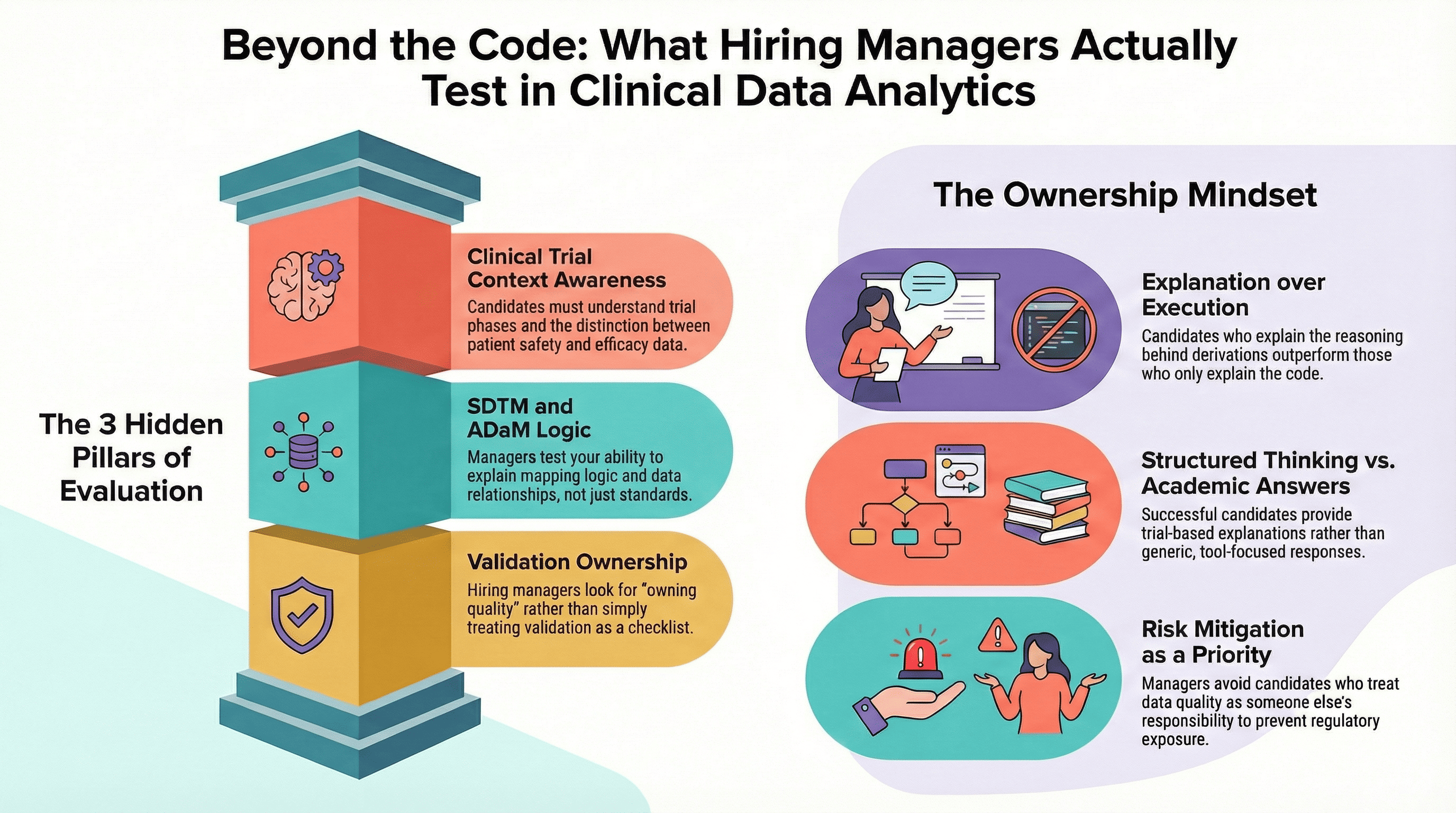
What Hiring Managers Test First (Even If They Don’t Say It)
1. Clinical Trial Understanding
Before code, hiring managers test whether you understand:
- What phase of a trial the data belongs to
- Why certain variables exist
- How patient safety and efficacy data differ
In even a mid-sized clinical trial, datasets may span hundreds of variables across multiple domains, each tied to protocol-driven decisions around safety, efficacy, and compliance.
Candidates who treat clinical data like generic datasets lose credibility early.
2. SDTM and ADaM Logic
Most interviews include indirect testing of:
- Dataset structure awareness
- Mapping logic
- Derivation thinking
You don’t need to recite standards. You need to explain why data is structured the way it is.
Hiring managers look for candidates who understand how raw data is progressively transformed across SDTM and ADaM layers, with traceability maintained at every step.
Candidates who memorise domains but can’t explain relationships struggle here.
3. Validation Thinking
Validation is where many candidates fail.
In regulated environments, validation failures are among the most common causes of submission delays, often requiring multiple correction and re-review cycles before approval.
Hiring managers test:
- How you check your own work
- Whether you can spot inconsistencies
- How you explain errors
Hiring managers assess whether a candidate can reduce validation risk—not just execute checks—because validation errors scale quickly across studies.
There is a difference between running checks and owning quality. Interviews are designed to expose that gap.
4. Ability to Explain, Not Just Execute
Clinical analytics is collaborative. You will need to explain:
- Dataset derivations
- Assumptions made
- Why certain logic was used
Clinical analytics work involves cross-functional communication with data managers, statisticians, medical reviewers, and QA teams, making explanation skills as critical as technical execution.
Candidates who say “that’s how the code works” instead of explaining reasoning are rarely selected.
Common Mistakes Candidates Make
Some patterns appear repeatedly during interviews:
- Over-focusing on tools instead of process
- Giving academic answers instead of trial-based explanations
- Treating validation as a checklist item
- Avoiding responsibility for data quality
These mistakes signal risk in regulated environments—and hiring managers are trained to avoid risk.
These patterns signal increased regulatory and delivery risk, which is why otherwise qualified candidates are often rejected despite strong resumes.
What Actually Separates Shortlisted Candidates
Candidates who move forward consistently demonstrate:
- Clear understanding of trial context
- Structured thinking around data flow
- Comfort explaining decisions
- Awareness of regulatory expectations
They don’t necessarily know everything—but they show ownership mindset.
That matters more than perfection.
Why This Matters for Both Candidates and Employers
For candidates, understanding hiring logic prevents wasted preparation on the wrong things.
For employers, misaligned hiring leads to:
- Rework
- Delays
- Regulatory exposure
This is why clinical analytics hiring remains conservative and selective, even when demand exists.
Closing Thought
Clinical Data Analytics hiring is not about who knows the most commands—it is about who can be trusted to make defensible decisions in regulated environments.
Those who prepare with this reality in mind stand out quickly.
If you’re preparing for clinical data roles—or hiring for them—understanding how hiring decisions are actually made helps reduce both career and delivery risk. Future editions will continue breaking down these expectations in practical terms.